The Internet Taught Us to Hate. Now It’s Teaching Us to Kill.
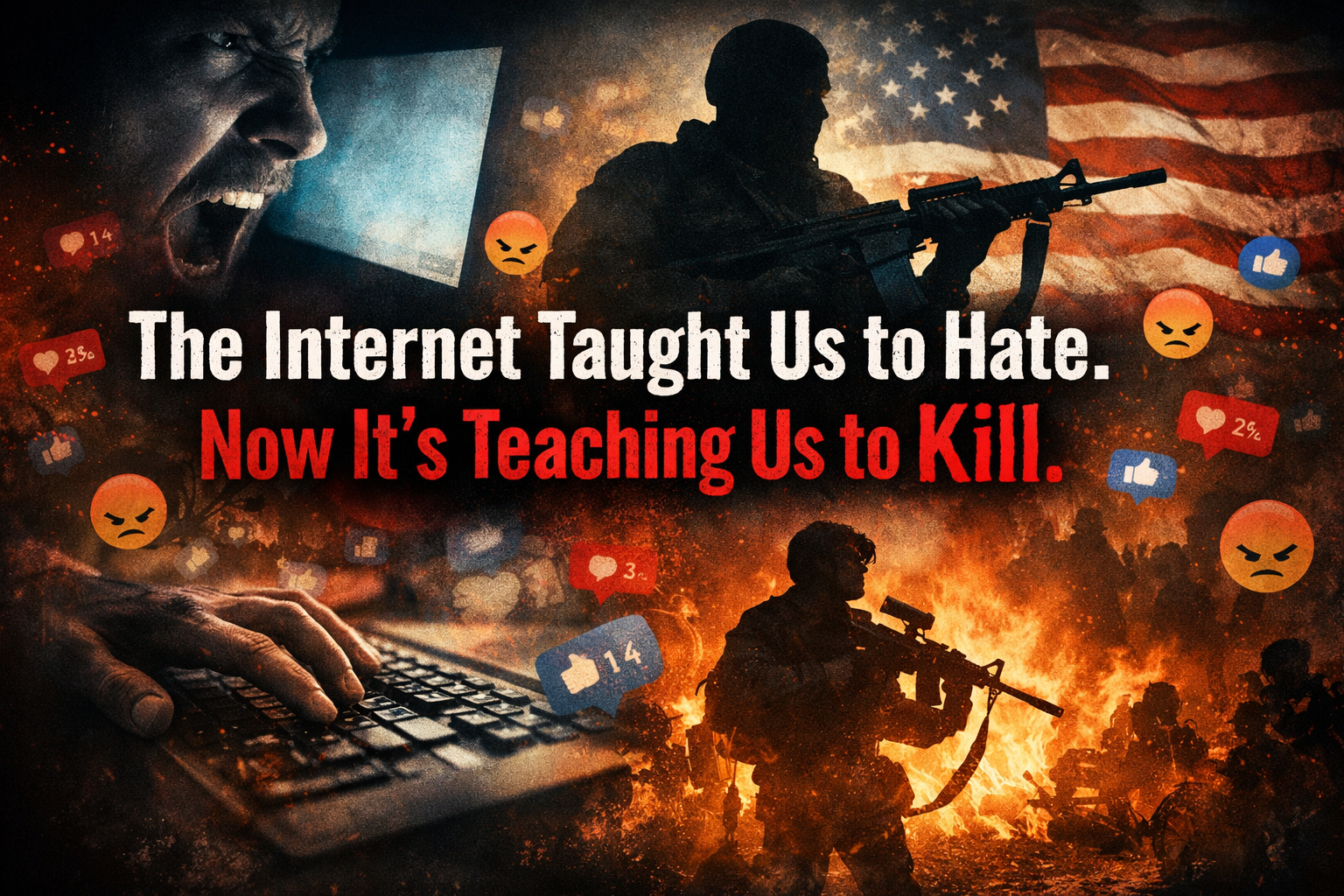
I remember 2016 vividly. Facebook comment sections were war zones. Friends argued. Families blocked each other. People said cruel things behind profile pictures they’d never say in person. Politics became personal. Identity became ammunition. But there was still a boundary most people respected. We fought with words, not bullets. Violence lived outside the arena of political disagreement. It was understood, almost instinctively, that no matter how angry we became online, the real world remained governed by restraint.
A decade later, that boundary has eroded.
Now I scroll through comment sections where strangers casually call for shootings. Where people justify killing law enforcement. Where users claim constitutional amendments grant them the right to execute political opponents. Where civil war is discussed not as a tragedy to be avoided, but as a fantasy to be accelerated. What once would have shocked the internet now passes with a handful of likes and laughing emojis.
This did not happen overnight. And it did not happen by accident.
In 2016, online political conflict was hostile but still largely rhetorical. In 2026, portions of online discourse have crossed into open endorsement of violence. That shift has real-world consequences. Reversing it requires cultural restraint, not escalation.
Back then, we were warned. We joked about it, even. That hiding behind screens would make people crueler. That anonymity would erode empathy. That algorithms would reward outrage. We told ourselves we were self-aware enough to escape the damage. “Not me,” we said. “I know better.” But culture is not shaped by individuals alone. It is shaped by repetition. By normalization. By what we tolerate in public spaces.
And slowly, the tone changed.
What began as sarcastic threats turned into half-serious hypotheticals. Half-serious hypotheticals turned into explicit justifications. And now, for a visible minority online, political violence is not just acceptable. It is righteous. It is framed as self-defense. Liberation. Moral duty. Once that mental switch flips, democracy becomes impossible. You cannot coexist with someone you believe deserves death for disagreement.
Much of this escalation rests on misinformation. Constitutional amendments stripped of context and repurposed as kill-switches. Historical analogies flattened into memes. Every political opponent cast as a tyrant. Every policy dispute inflated into existential threat. When history is misused and law is misunderstood, violence begins to feel reasonable to those already emotionally primed for it.
Algorithms accelerate the process. Outrage spreads faster than nuance. Fear travels farther than context. Content that enrages is rewarded. Content that calms is buried. Over time, users are nudged toward communities where escalation is the norm and restraint is framed as weakness. The comment section becomes not a forum, but a training ground.
The consequences are no longer theoretical. Offline harassment. Threats. Armed standoffs. Politicians requiring security details. Law enforcement treated as enemy occupiers. Families severed over imagined battle lines. Trust evaporates. Once that trust is gone, institutions cannot function. And once institutions fail, violence no longer needs encouragement. It becomes expected.
Here is where I plant my flag.
I disagree with much of what the modern left supports. I reject much of what progressive activism demands. But I will never turn a gun on my fellow Americans because of political disagreement. That is the end of the line. Once a movement believes its opponents deserve death, it has abandoned democracy. Once citizens accept violence as political currency, the republic is already dead, even if the flag still flies.
Calling for restraint is not weakness. It is maturity. It is understanding that the nation cannot survive if every disagreement is framed as a war to be won rather than a debate to be navigated. No policy victory is worth a blood-soaked country. No ideological purity is worth neighbors fearing each other.
The solution is not censorship, nor forced unity, nor manufactured consensus. The solution is cultural. We must re-establish the taboo against political violence. We must shame those who casually endorse it. We must demand intellectual honesty from those invoking history. We must refuse to laugh along when someone jokes about killing opponents. Every civilization has lines it does not cross. Once crossed, rebuilding takes generations.
In 2016, we fought with keyboards. In 2026, some are reaching for weapons. That trajectory is not inevitable. But it will not correct itself. It requires people willing to say, clearly and without apology: this stops here.
Not because we agree.
But because we intend to survive each other.
