THE MINNESOTA WE NEVER GOT: School Lunches
A Missed Table
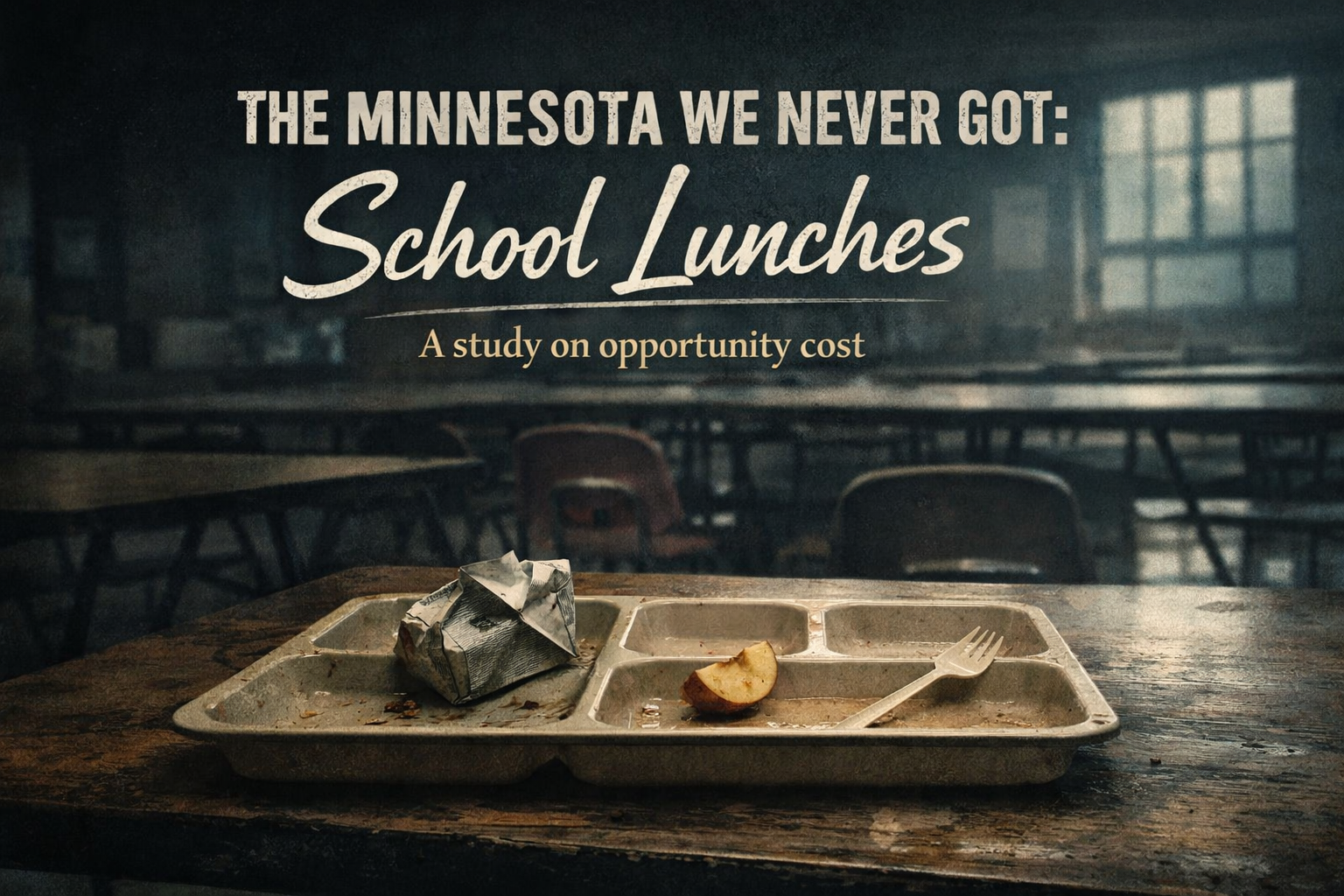
A lunch tray sits on a table in a school cafeteria.
A child sits nearby, eyes forward, shoulders slightly slumped, not hungry, but not entirely satisfied either.
For generations, that tray has been one of the quiet supports holding up childhood in America. Simple. Expected. Ordinary. Reliable.
But what happens when the money meant to fill those trays never arrives?
During the COVID-19 pandemic, food insecurity, already a stubborn national issue, spiked once school doors closed and millions of children lost their daily source of nutrition. School meal programs instantly became a lifeline. In response, emergency federal child nutrition funds and flexibility were deployed to try to fill the gaps left by closed cafeterias.
One Minnesota organization, Feeding Our Future, was supposed to be part of that solution. What unfolded would instead become one of the largest pandemic-era fraud cases in the nation, diverting hundreds of millions of dollars away from the very children it was meant to feed.
The Intended Purpose of Feeding Our Future
As schools nationwide pivoted during the pandemic, regular meal service halted. Millions of students found themselves missing out on what for many had been their most reliable meal of the day.
To respond, the U.S. Department of Agriculture and state agencies expanded emergency nutrition programs to reach children outside of traditional school cafeteria settings.
In Minnesota, Feeding Our Future, a nonprofit founded in 2016, became a state-sponsored sponsor for the Federal Child Nutrition Program. It rapidly expanded its reach, continuing meal distribution to children who suddenly had nowhere else to turn.
Under normal conditions, sponsors help schools and community partners serve reimbursable meals to children through established meal programs. With pandemic rule changes and urgent need, the system was urged to move fast. Built on urgency, trust, and compassion.
But urgency without oversight proved vulnerable.
Child Hunger in Minnesota Before the Fraud
Even before COVID, hunger was an ongoing challenge in Minnesota. According to Feeding America, about one in seven children in the state were food insecure. Meaning they lacked consistent access to enough food for an active, healthy life.
Across Minnesota’s school districts, many students qualified for free or reduced-price lunches under federal guidelines that identify children from low-income households. This designation doesn’t equate perfectly with hunger, but it closely tracks economic vulnerability and the real risk that a child enters school without assurance of their next meal.
When the pandemic hit, school lunch became more than a convenience. It became essential.
The Scale of the Fraud
What was meant to be an emergency lifeline turned into an extraordinary exploitation.
Feeding Our Future and dozens of associated sites and individuals participated in a scheme that federal prosecutors now confirm diverted $250 million from a federally funded child nutrition program… funds meant to reimburse meals served to disadvantaged children during the pandemic.
This is not speculation. It is confirmed by federal indictments and convictions, part of multiple cases brought by the U.S. Attorney’s Office for the District of Minnesota.
Dozens of defendants have pleaded guilty or been convicted for their roles in the scheme, from falsifying meal counts and attendance records to laundering reimbursements intended for food service back into personal accounts and luxury purchases.
This was once a small nonprofit handling a few million in reimbursements; at the height of the scheme it was connected to hundreds of millions in claimed federal funds.
Translating Dollars into Meals
Numbers like "$250 million" are big. Abstract. Hard to feel. But we can make it tangible.
In the United States, all states follow the same federal structure. School lunches served under the National School Lunch Program are reimbursed at tiered rates depending on income eligibility, with most free lunches reimbursed at rates around $4.43 per meal before supplemental state support.
If you take a conservative estimate of roughly $5 per meal for calculation purposes:
$250,000,000 ÷ $5 ≈ 50,000,000 meals
Fifty million meals that could have been served to children during a time of real need.
Visualizing 50 Million Meals
To visualize what 50 million lunches looks like:
Minnesota has over 800,000 students enrolled in public schools.
If each child ate one free lunch per school day, 50 million lunches would be enough to feed every one of those students for more than 60 days of the school year.
Translate that into school calendars: nearly four months of meals for all students.
Or think smaller:
In a school of 1,000 students, that’s 50,000 lunches, equivalent to one full year of meals for nearly 100 students.
This wasn’t abstract money in a spreadsheet. This was opportunities lost for nourishment, focus, and stability!
This wasn’t just stolen money.
It was stolen mornings.
Stolen afternoons.
Stolen relief.
Why School Meals Matter
School meals are not merely calories on a tray. They are infrastructure.
Nationally, programs like the National School Lunch Program serve nearly 22 million free lunches daily, reaching children who might otherwise go without.
Research links consistent access to nutritious school meals with better concentration, improved test performance, and fewer absences, outcomes tied directly to a child’s ability to learn and thrive.
Classrooms become quieter. Sleepier eyes lift. Thoughts clear. One meal does not solve every problem, but it removes one barrier that educators often describe as visible every day in the classroom.
The Opportunity Cost
This series is about opportunity cost, about what Minnesota could have had.
With 50 million lunches served responsibly, what might have changed?
Broader universal meal coverage for all students
Lower food insecurity across communities
More consistent attendance
Better long-term academic outcomes
Instead, millions in federal pandemic relief went through a system that was exploited, leaving behind investigations, convictions, and public distrust.
The Minnesota we never got is visible in empty trays.
Accountability and Repair
There is accountability, slowly.
Federal prosecutors have secured guilty pleas and convictions. Individuals involved in the fraud have been sentenced, some facing decades in prison. Oversight rules have been rewritten. Audits expanded. Safeguards tightened. That matters. Systems should learn. Institutions should improve. Public trust deserves repair.
But no sentence handed down in a courtroom can retroactively serve a missed meal. No recovered dollar can return a lost school day spent hungry. Justice addresses wrongdoing. It does not refill empty trays from years past. Reform isn’t partisan. It’s preventive. It’s the recognition that compassion must be protected from exploitation, especially when the people meant to be protected are children.The next program will come. Another emergency. Another moment requiring urgency and trust. The question is whether we will have built systems worthy of that trust, or whether we will once again discover the cost only after the table is already empty.
Research Links
A Decade of Program Fraud and Fiscal Vulnerability in Minnesota (2016–2026)
The Cost of Fraud and Undocumented Immigration in Minnesota (2016–2026)
Explore the Series
This piece is part of The Minnesota We Never Got — a series examining opportunity cost in public policy.
Continue reading:
• THE ROADS — Infrastructure we could have built
• SCHOOL LUNCHES — Meals we could have served
• [Upcoming] HEALTHCARE GAPS — Coverage we could have expanded
Closing Line
A state is measured not only by what it builds, but by what it chooses to feed.
If you want sections expanded, stats visualized, or quotes added from local educators or families, just let me know and we can build those in.
